2012-01-20

Digital Transition

So it turns out we're going fully-digital in March (the Midhurst transmitter). This, apparently, explains why we've got absolutely shonky Freeview reception at the moment. Channels disappearing, then re-appearing, appallingly broken-up pictures and sound etc. Ahh, digital. Degrades so much more finally than Analogue...


My parents went this time last year. My dearly sainted mother described the process as "the picture was horrible or unwatchable for a couple of months. Then your father retuned and it got better".  Well, we've got the same.

Since about Jan 10th , the BBC multiplex (Mux-1) has been fine. But availability of everything else has been spotty: poor to nonexistent during the day, occasionally fine in the evening, rarely good late at night.

Nerd that I am, I've managed to track this behaviour on my Myth box using "tzap". 

Here's a working channel:

 tzap -a 0 -f 0 -d 0 -c scan_localfreq_channels.conf 'BBC ONE'
using '/dev/dvb/adapter0/frontend0' and '/dev/dvb/adapter0/demux0'
reading channels from file 'scan_localfreq_channels.conf'
tuning to 754000000 Hz
video pid 0x0258, audio pid 0x0259
status 1e | signal 0000 | snr 0000 | ber 001fffff | unc 0000303d | FE_HAS_LOCK
status 1e | signal 0000 | snr 0000 | ber 000000d0 | unc 00000000 | FE_HAS_LOCK
status 1e | signal 0000 | snr 0000 | ber 00000080 | unc 00000000 | FE_HAS_LOCK
status 1e | signal 0000 | snr 0000 | ber 000001c0 | unc 00000000 | FE_HAS_LOCK


And here's one that's probably not right now:


tzap -a 0 -f 0 -d 0 -c scan_localfreq_channels.conf 'Channel 4'
using '/dev/dvb/adapter0/frontend0' and '/dev/dvb/adapter0/demux0'
reading channels from file 'scan_localfreq_channels.conf'
tuning to 826166670 Hz
video pid 0x0230, audio pid 0x0231
status 1a | signal 0000 | snr 0000 | ber 001fffff | unc 00000000 | FE_HAS_LOCK
status 1a | signal 0000 | snr 0000 | ber 001fffff | unc 00000015 | FE_HAS_LOCK
status 1a | signal 0000 | snr 0000 | ber 001fffff | unc 00000000 | FE_HAS_LOCK


Spot the differences? Status = 1e on BBC1, 1a on Channel 4. Constant high Bit Error Rate on C4, variable but much lower on BBC1.

Later in the evening I might get to see actual values for "signal" and "snr" (Signal-to-Noise) on both channels, which is an indication all is working well at the minute.

Now the experience of my parents above means basically that I should just sit back, wait until the switchover is complete in mid-March, and then start worrying if I can't get it to work again. And I'm mostly resigned to this. But I have a nagging feeling I'm actually looking at a local problem, not a switchover artefact: Up in the roof we've got a signal booster, tucked away where we can't see it. And I'm wondering whether it's gone "phut" recently....

2012-01-13

Back Garden Astronomy - 2012-01-13

Very cold out tonight (Google says currently -2C) which combined with poor optical conditions meant only a short go with the 'scope tonight of about an hour.

Poor conditions were a disappointment; I think it's mostly dew / fogging on the scope (I was taking care to keep my frosty breath away as much as possible). Couldn't get good focus on stars and a massive halo around Jupiter.

Nonetheless, got some seeing in of:


  • Jupiter - Closer to vertical than on previous views (well; it's just past South at peak altitude, what did I expect?). Nice to see an out-of-plane moon although I've had to verify in Stellarium that it wasn't anything else (Callisto; Io's on closest-to-Jupiter in-plane duty tonight).
  • Betelgeuse - Much redder than I was expecting, although some of that might be exaggerated due to diffraction and the focussing problems I was having. Very distinctive though.
  • Aldebaran - Again, much more colour than I was expecting
  • Pleiades - Would be a fascinating object to study with the right equipment; I was getting too cold to do it justice
  • Procyon - Again, quite distinctive but couldn't get steadied down enough to have a good gander.


As ever, though, it's the surprises that make it. As I was eyes-out looking around for a good target, at about 2045ish, a very large very bright orange fireball went over from about Jupiter (South-South-West) pretty much due-north. It's the first time I've seen one leave a big trail, with visible "sparks" breaking off. It got right overhead and disappeared (burnt out?) about 45 degrees above North. The whole thing only lasted about 10 seconds from appearing, growing a tail, particles streaming off, to disappearing. Very impressive. If I lived elsewhere and it'd been East-West I'd have guessed it might have been Phobos-Grunt re-entering.

2011-12-19

OK, G+, is *this* the killer app?

Since I'm demonstrating a visible lack of care about my online privacy or any of the social media implications, I clicked the "OK link to Google+" button on my Blog. Thus revealing my true name and any number of linked bits of information.

Mostly I'm interested to see what if anything happens: G+, after an initial flurry, seems to be settling down to the Google Wave lifecycle, rather than undergoing Facebook-like take off. I mostly only visit G+ after I've exhausted all other forms of update: Google Reader first, Twitter second, Facebook third, Reddit fourth and usually that's enough. If I'm still feeding for info and I've exhausted all those sources, maybe I'll click on Google+ but only to be disappointed by all the duplicate info posted way later there than elsewhere.


Honestly I don't know what Google's got to do to make G+ a success. I suppose I'm just sat around like everyone else here waiting for the next shoe to drop...

Merry Christmas to All Our Reader!

2011-11-01

iOS5: Apple's implementation of "Nudge" theory...

I've been very happy with the features that iOS5 has brought to my iPhone 3GS. When I bought it, over 2 years ago, I had a (nominally) single-tasking device that could read HTML5 web pages, run some cool apps, find it's location and orientation anywhere in the world, and Do Email.

In the 2 years since, I've gained multitasking (of a sort), full real-time sync of email, contacts and calendars (including shared calendars - but I have developments at Google to thank for that, not Apple), a good-enough Reminders / To Do list application, Real-time stalking location tracking of friends and family, and finally a Notifications system worthy of the name.

But with iOS5 there's a price to pay, and it's performance: my iPhone has gone from snappy, instant response to taking a couple of seconds to load a new App (longer for 3rd party ones). The increase in memory load of the OS is notable in Safari where it's now rare for switching tabs not to cause the page to reload (a sign it's been stolen from memory and now needs to be re-retrieved and rendered), and on occasion I've had 10-second freezes where launching an application has caused some sort of Grim Reaper to go around in the background and start killing off unused apps. All of this is taking it's toll on the User Experience (and also battery life, always the smart phone's Achilles heal).

But my phone is 2 years old, and despite it still being sold (as the entry-level iPhone aimed at emerging markets), I have a feeling Apple have very little interest in spending much time performing the performance tuning and optimization for it. Indeed, if I were a more cynical man than I undoubtedly am, I would suspect that here is an excellent opportunity to Nudge fans of the iPhone like myself towards a replacement purchase: Here are all these great features, they may say, and don't you think they'd work better on a newer phone? Available right now from an Apple Store near you!

Anyway, my iPhone 4S is waiting for me at home once I return from this trip. Damn you, Brain, for being so easily led...


2011-10-14

iOS 5: Everyone else has a snap judgement on it, here's mine

Things I like about iOS 5:
  • PhotoStream, 
  • WiFi sync, 
  • Stalker Mode (AKA "Find my Friends")
  • The excellent new Notifications system
  • Reminders
  • iCloud backup

Things I don't like
:
  • Sync'd playlists don't retain sort order (my podcasts aren't listed by publication date. Nyah!), 
  • My poor 3GS is now noticeably low on memory given how much applications are swapping, 
  • I've had at least one lockup of the phone changing tracks
  • A failed WiFi sync caused iTunes to view it as a new phone and trash the contents leading to a very late night rebuild.

But if I'd have wanted a quiet life I'd have waited for iOS 5.1, wouldn't I?

2011-08-10

Stargazing

I had what amounts to a religious experience last night.

Let me explain: For my *cough* significant *cough* birthday, my Dearly Beloved indulged me with a recent whim: a brand new Telescope. Nothing too fancy, I am a dilettante and a newcomer, not an expert or an obsessive. Nonetheless, the Celestron NexStar 102SLT is a fine piece of kit, a 4.5" refractor with a smashing computer-driven mount, making finding and locking on to interesting things a matter of calibrate, select from menu, press button and observe.

However, as always there has been a problem and in this case it's environmental. Apart from one try-out after it arrived (which mainly proved how well the calibration and tracking worked), either the weather's been overcast or I've not been around to try it out.

Thus it was that when I observed at about 21:00 last night that there was a bright moon and nearly clear skies, the glass of white wine inside me convinced me it was well past time to take up station in the back garden in shorts and sandals and see what I can see.

My preferred target would have been a planet - I'm dying to see Saturn's rings or as many of Jupiter's moons as possible - but the plane of the ecliptic is on the street side of our house, where the bright sodium lights & obscuring neighbour houses together with a minimal sense of decorum prevented me setting up. Besides, at this time of year Saturn's setting pretty much with the sun so I had no chance.

This left me with the mostly-Northern sky to observe, and thus deep-field objects rather than anything in the solar system. Stars are fine, but I'm not experienced enough to navigate the skies myself or to particularly tell the difference between them. So I used the "Tour" function on the 'scope to find me something a bit more than a point-light-source to look at.

I was rewarded with a l-o-n-g list of nebulae and galaxies above the horizon to choose from. I was pre-warned from my reading of the manuals etc that observing such far away objects by eye with such an amateur scope was unlikely to produce great results. However, I gamely selected the Andromeda Galaxy, waited as the 'scope slewed around, and put my eye to the objective.

I was rewarded with a smudge. A dim smudge, with a few pin-point stars around it. My natural conclusion was a spot on the lens, or perhaps a passing cloud. But slewing around, then back made the smudge re-appear, and keep the same position.

And here's the religious part of the experience: I saw a galaxy, but it requires faith on my part to believe that that dim smear between a bunch of stars is the light resulting from about a trillion stars 2.5 million light years away, rather than some sort of aberration of the 'scope or the heavens.

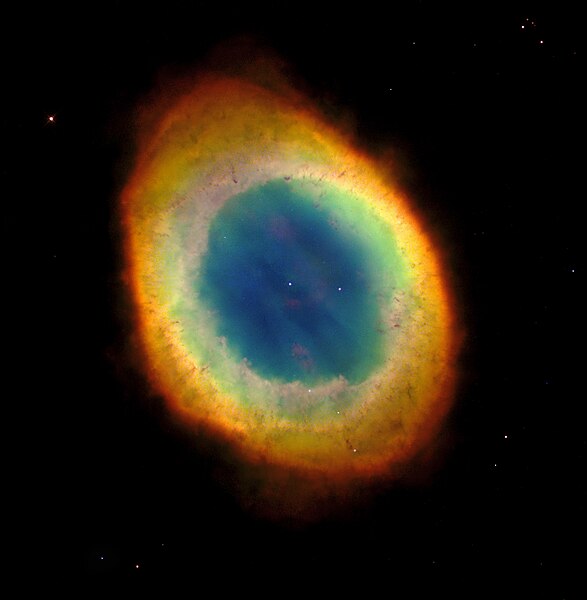
Intrigued and a little humbled by the experience - my own puny ageing weak eyes, gazing myopically on photons older than my species - I tried again. M2 was the same, the Dumbbell Nebula even weaker. Finally I tried the Ring Nebula which was far above the house.

If you google for it, you'll find pictures that look like this:
(Picture copyright NASA, taken from Wikipedia)

Whereas what I saw through my 7mm 72x magnification view looked more like this:

(Screenshot from Stellarium, post-processed to simulate actual view)

That smudge in the middle there is a ring about 1/2 a light year in diameter, 1,400 light years from here and the remnants of an exploded red giant star. Nerd that I am, I find the fact that I can see anything at all quite inspiring, as with Andromeda the implications of what I was able to see with my own eye are far, far more impressive and humbling than the image in any way suggests.

In many ways the experience - far from being a disappointment - gave me a new appreciation of the work of astronomers. Before the age of photography, this was all they ever saw and yet the star maps of even two centuries ago contain wonderfully detailed observations. The leap of intuition to go from "there's a smudge in the sky" to "That's another Galaxy, with more stars than our own, inconceivably far away" blows me away. 

I don't have the time, inclination nor (I strongly suspect) the intellect to get there myself, therefore I am in a position of having to have faith that what I was looking at was as described; I will never be in a position to prove this for myself.

But nonetheless it was a rewarding experience I look forward to repeating...


2011-07-19

Using a Vodafone K4511 3G USB Dongle on Linux

There's plenty out there for those with Vodafone's previous stick, the Huawei K4505, but they've recently switched to providing a new model, the K4511. Although the dongle comes with support for Windows and Mac, I haven't found any pre-configured support for Linux.

Rather annoyingly I'm now using a fairly odd choice of distro, based around RHEL 6.1. Which means most people who might chance across this post will inevitably have to do something different. But as a pointer anyway, here's what I needed to do to get it working:

  • On insertion, "lsusb" will present Vendor=0x12d1, Product=0x14b7. There are currently no provided usb_modeswitch configs for this, so no device class will manifest. 
  • Make sure you've installed the latest "usb_modeswitch" and (if separate) "usb_modeswitch-data" packages for your distro.
  • Create the file /etc/usb_modeswitch.d/12d1:14b7 (hint: the colon needs escaping. Try "vi /etc/usb_modeswitch.d/12d1\:14b7" to create it)
  • Make the contents of this file as follows:
# Huawei, newer modems

DefaultVendor= 0x12d1
DefaultProduct=0x14b7

TargetVendor= 0x12d1
TargetProduct= 0x14cc

CheckSuccess=20

MessageContent="55534243123456780000000000000011062000000100000000000000000000"

(Note: I copied the existing 12d1:1446 file and modified only the "DefaultProduct" and "TargetProduct" values to get this output. What I'd have done if a different "MessageContent" was required, I have no idea...)

  • Edit the existing /lib/udev/rules.d/40-usb_modeswitch.rules file. Add a (single) line:
ATTRS{idVendor}=="12d1", ATTRS{idProduct}=="14b7", RUN+="usb_modeswitch '%b/%k'"

(Note: Again, I copied & modified the existing line for device 12d1:1446)


  • For debugging purposes, you may want to set "EnableLogging=1" in /etc/usb_modeswitch.conf. If you do, files will be produced in /var/log/, in particular usb_modeswitch_3-4:1.0 will show the results of the switch, and you'll also get usb_modeswitch_ttyUSB[0-4] if it works.
  • Now insert the USB Dongle. After a short pause, it should be re-configured as a Modem *AND* a CD-ROM device - I get the file "10.2.102_RC1" appearing on the desktop as that's the firmware version loaded as a virtual CD device.
  • Configure NetworkManager as normal for a "Mobile Broadband" connection - I found the wizard supplied all the right defaults
  • Connect as normal - click the NetworkManager icon, select the Mobile Broadband connection you configured, and it should connect. After connection, click again and you'll see the service type (GPRS/EDGE/3G) and current network strength bars.
  • It's probably best to right-click the virtual CD device and "Eject" or "Safely Remove Drive" it before unplugging the stick, although I haven't had anything nasty happen to me yet when I've forgotten.
For Distros with no /etc/usb_modeswitch.d directory and/or files, you should get the same results by editing whatever's driving udev on your platform and adding something like:


usb_modeswitch -v 0x12d1 -p 0x14b7 -V 0x12d1 -P 0x14cc -M 55534243123456780000000000000011062000000100000000000000000000 -s 20

It's possible you might have to add some voodoo to ensure the option module is loaded to handle the /dev/ttyUSB[0-4] devices; I didn't have to bother as udev handled that for me automatically.